

About the Project
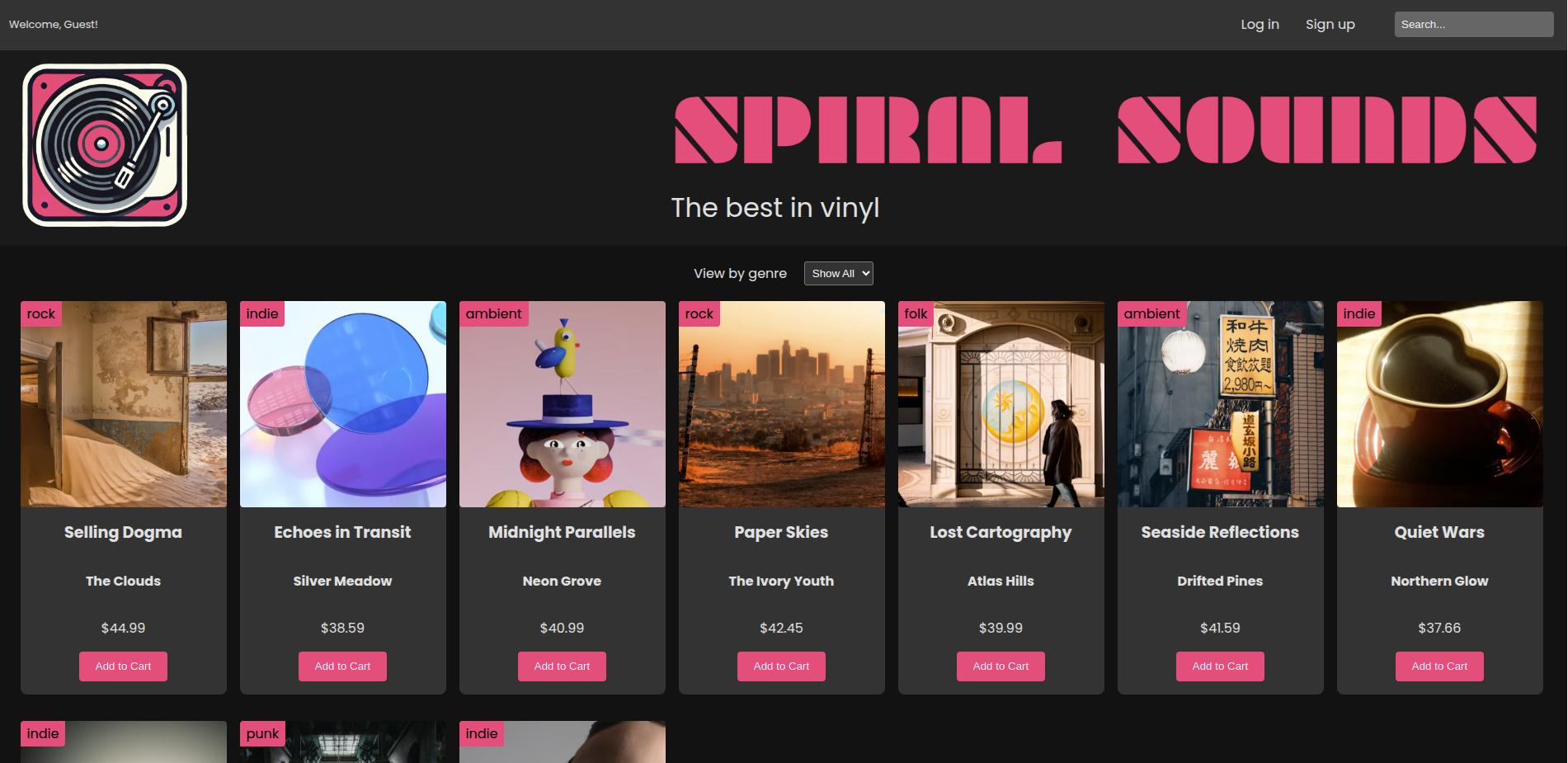
Vinyl Store is a vinyl-record e-commerce app: a searchable, genre-filterable catalog, a per-user persistent cart, and session-based authentication — built as a minimalist Express API served entirely as a Netlify serverless function, with a plain HTML/CSS/JS front end (no framework) on top.
The code is public at github.com/cristiangiehl1/vinyl-store, deployed at vinyl-market.netlify.app.
The Problem
The goal was to put together a complete e-commerce flow — catalog, cart, login — without the overhead of a full-stack framework, and host it on a platform with no always-on server. That raises two architectural questions the project answers directly:
- How do you keep a user session in a stateless API, where each request can land on a different function instance with no shared memory between invocations?
- How do you serve a whole Express API (multiple routes, multiple domains) behind a single serverless function, instead of splitting the logic into one function per endpoint?
Architecture
The whole API runs as a single serverless function: netlify/functions/api.js builds an Express app from scratch, registers express.json() and cookie-parser, mounts the appRouter at /api, and wraps everything with serverless-http — the same Express route tree (auth, sessions, products, cart) handles any path under /api/* from that one entry point, instead of one function per resource.
- Controllers (
controllers/) — one file per domain (authController,sessionsController,cartController,productsController), plus a sharedcontroller.jsthat centralizes reading/writing the session cookie. - Routes (
routes/) — one router per domain, mounted on the centralappRouter; the cart is the only route group that requires authentication, applied once at the mount point (appRouter.use('/cart', requireAuth, cartRouter)) rather than in every handler. - Middleware (
middleware/requireAuth.js) — validates the session cookie against the database and injectsreq.userId. - Infra (
infra/database.js) — Postgres access; migrations versioned withnode-pg-migrate.
Session-Based Authentication in the Database
Instead of JWTs or signed cookies, the session is an opaque token persisted in Postgres:
- On register or login, the password is checked with bcrypt and a random 48-byte token (
crypto.randomBytes(48)) is generated. - The token is written to the
sessionstable (user_id,token,expires_at, 30-day validity) and returned to the browser as asessionIdcookie —httpOnly, andsecurewheneverNODE_ENV !== 'development'. - On every protected request,
requireAuthruns aJOIN sessions ⋈ usersfiltered byexpires_at > NOW(); if no valid session is found, it clears the cookie and responds401. - Logout doesn't delete the row — instead of a
DELETE, it subtracts one year fromexpires_at(expires_at = expires_at - interval '1 year'), which invalidates the session immediately under the samerequireAuthcheck without losing the record of when that session existed.
This moves the session's source of truth entirely into the database — there's no in-process memory state, a direct requirement of the serverless environment, where the function can be restarted on any invocation.
Catalog and Cart
- Products (
products: title, artist, genre, year, price, stock, image) — listing with either an exactgenrefilter or a text search withILIKEacross title/artist/genre (the two modes are mutually exclusive in the same query); a helper endpoint (getGenres) returns the distinct genres already in the catalog, used to populate the UI filter. - Cart (
cart_items, cascade foreign keys tousersandproducts) — adding an item that's already in the cart increments its quantity instead of duplicating the row; there are separate endpoints for counting items (used by the cart badge), listing with aJOINintoproducts(title, artist, price already resolved), and removing a single item or clearing the whole cart. - The sample catalog (
data.js, used by the seed script) holds 10 fictional records — the project is an architecture showcase, not a real catalog.
Key Challenges
- Session without process state. Any in-memory cache in the Node process dies with every new function invocation. Persisting the entire session in Postgres — instead of, say, an in-memory
Map— was the only way for authentication to survive across requests in a serverless environment. - One connection per query, not a pool.
infra/database.jsopens a freshpgClienton everyquery()call and closes it in afinally. This sidesteps the classic problem of a connection pool left dangling between function invocations (a connection "forgotten" open from a previous one), at the cost of paying the connection handshake on every query — a deliberate trade of throughput for simplicity and safety in a serverless environment. - One function for the whole API. Since Express already handles routing internally, exposing each endpoint as a separate Netlify function would duplicate app setup (parsers, cookie-parser) in every one. Wrapping the entire
appRouterwithserverless-httpin a single function kept routing where it already made sense — inside Express itself. - Revoking a session without losing history. A
DELETEon logout would erase the record of when that session existed; expiring the date (expires_at - interval '1 year') invalidates the session under the sameWHERE expires_at > NOW()already used byrequireAuth, with no separate revocation logic needed.
Technologies Used
Backend
- Node.js / Express — API and routing.
- PostgreSQL (
pg) — user, session, product, and cart data; on-demand connections, no persistent pool. - node-pg-migrate — versioned schema migrations.
- bcryptjs — password hashing.
- cookie-parser — session cookie parsing.
- validator — email validation on signup.
Frontend
- HTML5 / CSS3 / JavaScript — static pages (
public/) consuming the API viafetch, no framework or bundler.
Deploy
- Netlify Functions — the entire Express API, adapted via
serverless-http, runs as a single function. - ESLint + Prettier — code standardization.
Technical Notes
- Authorization at the router edge, not in every handler.
requireAuthis applied once, atappRouter.use('/cart', requireAuth, cartRouter)— no cart controller needs to know authentication exists; all of them receive an already-validatedreq.userId. httpOnlycookie with environment-conditionalsecure. In local development (no HTTPS),secureis deliberately turned off so the cookie doesn't break; everywhere else (Netlify production), it's always on.- Configurable Postgres SSL.
infra/database.jsaccepts a custom certificate viaPOSTGRES_CAand, absent one, requires TLS in production and disables it in development — covering both a local Postgres in Docker and a managed provider with its own certificate.