
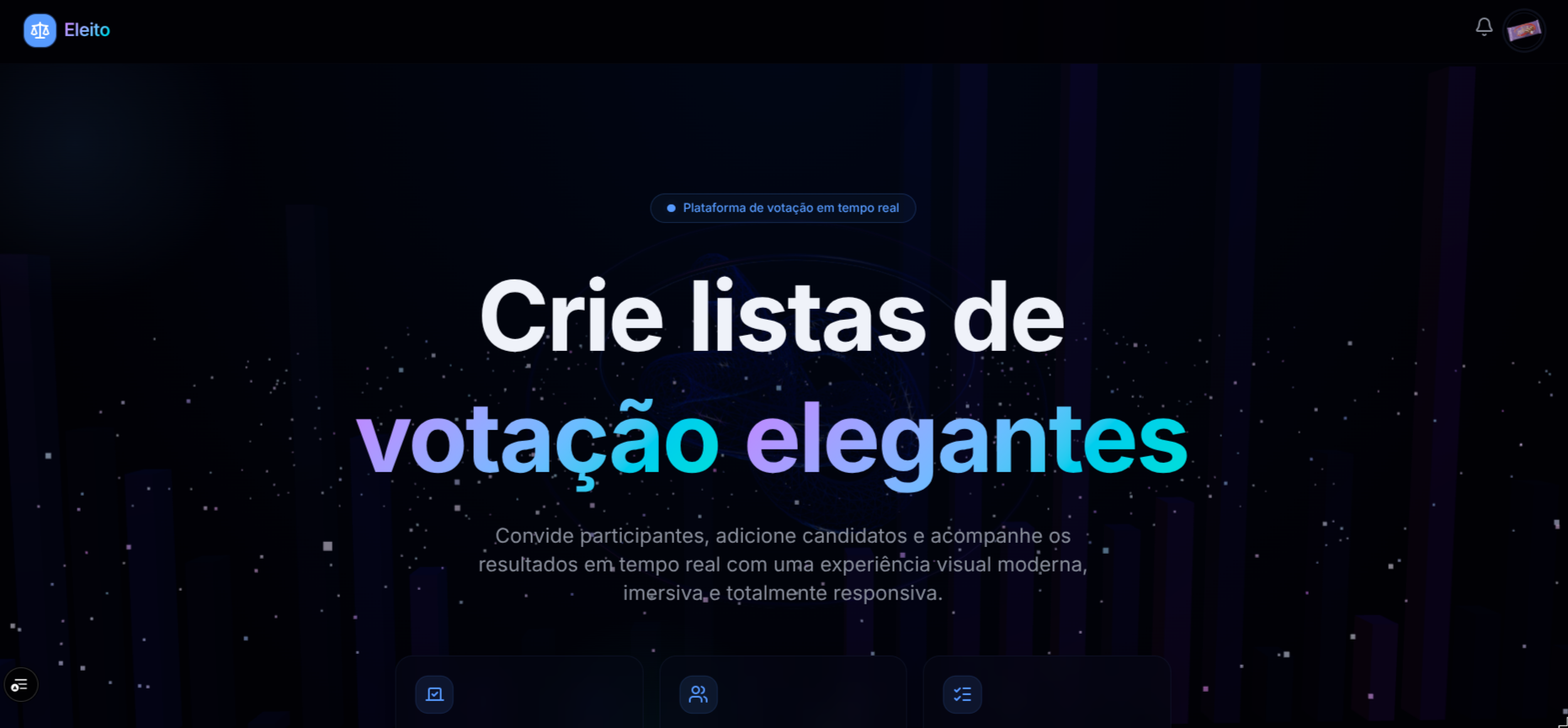

About the Project
Voting Lists (internal product name: Eleito) is a platform for creating custom voting lists: any user builds a list, adds options (people, movies, objects — anything), invites participants by email, and tracks the outcome. Each list carries its own configurable rules — simple or ranked voting, results visible or hidden until the end, an expiration date, public or invite-only — that change the behavior of the entire voting experience.
The Problem
Deciding something as a group through informal voting (a WhatsApp thread, a shared spreadsheet, a loose poll) quickly loses traceability: it's unclear who has already voted, the outcome gets mixed into the conversation, and rules like "everyone votes for up to 3" or "ranked preference" end up as a verbal agreement instead of an enforced constraint. The goal of the system is to formalize that flow — creation, invitation, voting, and tallying — with each list's rules applied consistently for every participant.
Architecture
The project is a full-stack Next.js 15 (App Router) application, with clearly separated layers between client and database.
- API Routes as thin controllers — every route validates the session (
NextAuth, JWT), validates the body with a Zod schema (lib/schemas), and delegates to the matching repository. No Prisma query runs outside the repository layer. - One repository per aggregate —
list,option,vote,invite,participant,friend,notification,user: each exposes specific functions (e.g.getResultsByListId,findInvitesByEmail) instead of a generic Prisma client scattered across the app. - Client state via TanStack Query —
hooks/queries(reads) andhooks/mutations(writes) wrap every call; there is no global application state outside the React Query cache. - Credentials-based auth — NextAuth with a
Credentialsprovider and JWT session: email + password (hashed withbcryptjs), requiringemailVerifiedbefore the first login. The useridand profile image are propagated into the token and the session via thejwt/sessioncallbacks.
Data Model and Voting Rules
The Prisma schema (VotingList, Option, Vote, Participant, Invite, Friend, Notification) encodes business rules as constraints, not just application-level validation:
- Per-list configuration — each
VotingListcarries its own flags:isPublic,revealVotes(show the count before the end),allowMultipleVotes,rankedVoting,maxRank(defaults to 5), andallowParticipantsToAddOptions. The Zod schema (createListSchema) enforces a cross-field rule: ranked voting requires multiple votes to be enabled — a list cannot be created withrankedVoting: trueandallowMultipleVotes: false. - One vote per option, per person —
@@unique([voterId, optionId])on theVotetable prevents voting twice on the same option; in ranked lists, each vote carries arank(preference position) instead of being a plain counter. - Ranked tally (Borda-style scoring) — when
rankedVotingis on,getResultsByListIdcomputes each option's total by summing, for every vote it received,maxRank + 1 - rank(a 1st-place vote contributes more points than a last-place one). In simple voting, the total is just the vote count. - Restricted participation —
@@unique([userId, listId])onParticipantguarantees a single entry per user in a list; only participants (or any visitor, if the list is public) can view/generate results, based onisPublic. - Email-addressed invites, resolved in-app — an
Inviteis created withlistId+email(idempotentupsert: resending an existing invite just resets its status toPENDING). The invite does not trigger an email to the invitee — it shows up on the/invitesscreen for any logged-in user with that email address, with the pending count refreshed by polling. Accepting the invite creates theParticipant; a list's pending-invite listing already excludes emails that are already participants. - Unauthenticated public sharing —
/share/[id]exposes a list, its options, and its results only ifisPublicis true, and hides individual votes whenrevealVotesis false (the route returns options withvotes: []), with no login required. - Friendship system — a
Friendmodel (request/accept/reject, with a unique index per user pair) exists independently of the lists, laying groundwork for a future social layer (e.g. inviting friends directly instead of typing an email).
Updates and Notifications
There is no WebSocket or Server-Sent Events: "real-time" updates are TanStack Query polling with a refetchInterval tuned per sensitivity — results for an ongoing vote every 10s (useResults, usePublicResults), notifications and their counter every 15s, and the pending-invites counter every 30s. It's a deliberately simple choice: no real-time infrastructure, trading a small delay window for zero persistent-connection complexity.
Every relevant event (vote received, option added/removed, invite accepted/rejected, list deleted, friend request) creates a Notification record, typed by an enum (NotificationType), read/marked-as-read by the user themself.
Image Upload
List, option, and profile photos go through /api/upload straight to Cloudinary, with server-side MIME type (jpeg/png/gif/webp/avif) and size (max 5MB) validation before the upload. Every image replace/remove goes through an ownership check: the Cloudinary publicId embeds the type (users/lists/options) and the owner, and the route confirms the authenticated user actually owns the list/option/profile before accepting the change — preventing a user from swapping another person's list image by tampering with the call.
Main Challenges
- Not promising more real-time than what exists. The temptation to call the polling "real-time notifications" was there from the start; keeping the intervals short (10–30s) and backed only by the React Query cache was the way to deliver a sense of constant freshness without the operational cost of persistent connections.
- Cross-field rule between
rankedVotingandallowMultipleVotes. Ranking without multiple votes makes no semantic sense (you can't order a preference with a single vote per person). Enforcing that dependency in the Zod schema, via.refine(), keeps the invalid state from ever being created — before any tallying logic has to deal with it. - Hiding results without hiding participation. When
revealVotesis false, the public route still returns the list of options (so people can vote), but zeroes out the votes array — instead of denying the whole request, which would break the experience for someone who just wants to vote without seeing the scoreboard. - Email-addressed invites without an invite email. Resolving the invite by the invitee's own account email (instead of a unique per-invite link) kept the flow simple, but ties the experience to "the invited person needs to have (or create) an account with that email" — a conscious limitation of the current model.
Technologies Used
Framework
- Next.js 15/16 (App Router) + React 19 + TypeScript
- NextAuth.js (Credentials + JWT) — authentication and session
- bcryptjs — password hashing
Data
- PostgreSQL + Prisma ORM — local Docker in development, Neon in production
- Zod — schema validation across routes and forms
Frontend
- Tailwind CSS + shadcn/ui (Radix UI)
- TanStack Query — cache, mutations, and polling
- GSAP — scroll/entrance animations
- next-themes — light/dark theme
Infrastructure
- Cloudinary — image upload and hosting
- Docker — local database
- Vercel — application deploy; the production build runs
prisma db pushbeforenext build
Technical Notes
- The repository layer is the only door into Prisma. No route calls
prisma.*directly; everything goes throughlib/repositories, which keeps each aggregate testable and makes the tally query (getResultsByListId) reusable between the authenticated route and the public sharing route. - Ownership is verified on upload, not just in the UI. The image ownership check happens in the upload route (server-side), not just by hiding the edit button on the client — the same "authorization at the edge of the action" pattern used in the other internal projects.
- The friendship model already exists but isn't consumed yet by list creation/invites — it's the most direct next extension of the product: inviting by friendship instead of typing an email every time.